
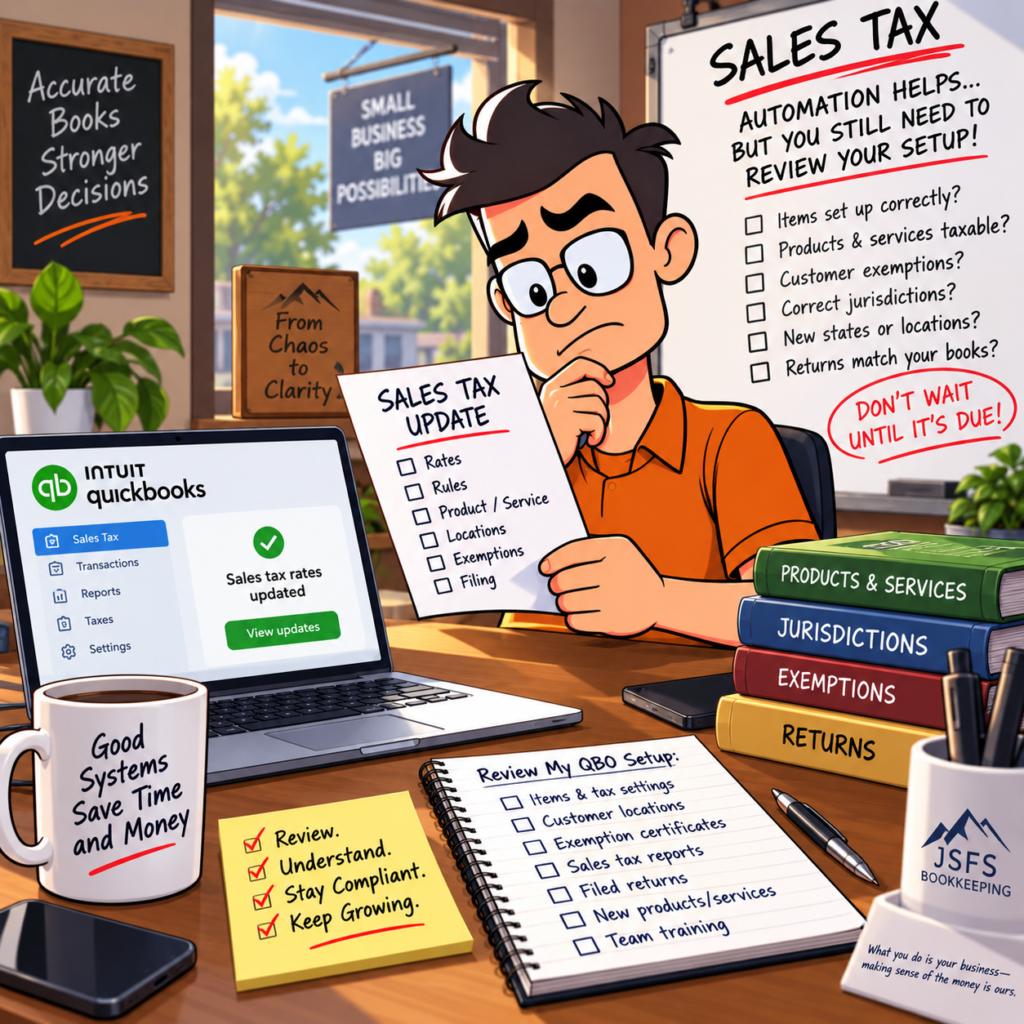
One of the great things about modern accounting software is automation.
One of the dangerous things about modern accounting software is also automation.
It is very easy to see the words Automated Sales Tax in QuickBooks Online and assume that sales tax is now something you never have to think about again.
Unfortunately, it doesn’t quite work that way.
QuickBooks can do a tremendous amount of the work for you, but the software can only calculate sales tax correctly when the information feeding the calculation is correct.
Sales Tax Is More Than a Percentage
When most people think about sales tax, they think about the tax rate.
But there are several questions that have to be answered before the rate even matters.
Is the product or service you’re selling taxable?
Where did the sale take place?
Where is the customer located?
Do you have a requirement to collect sales tax in that jurisdiction?
Is the customer exempt?
Is the item set up correctly in QuickBooks?
Are you selling something new that has different tax treatment from your existing products or services?
That is why a sales-tax rate update in QuickBooks shouldn’t just be background noise.
It is a good reminder to review your setup.
Automation Doesn’t Replace Review
I am a big believer in using technology to make bookkeeping more efficient.
I am not a believer in turning technology on and assuming it will take care of itself forever.
Automated sales tax can help determine rates based on information in the transaction. But if a product is incorrectly marked taxable—or incorrectly marked nontaxable—the calculation can still be wrong.
The same is true if customer information, locations, or other settings are incorrect.
Think of automation as a very fast employee.
If you give that employee the wrong instructions, they can make the same mistake hundreds of times much faster than you ever could manually.
Look at What Has Changed in Your Business
Even if your QuickBooks sales-tax setup was correct when you started, your business may not be the same business today.
Maybe you added a new service.
Maybe you started shipping products into another state.
Maybe you opened another location.
Maybe you began selling online.
Maybe you hired someone who is creating invoices differently.
Maybe you have customers who provided exemption certificates.
Those changes can affect how sales tax should be handled.
Your bookkeeping system needs to grow and change along with your business.
Don’t Wait Until the Return Is Due
The worst time to discover a sales-tax problem is when the return is due.
At that point, you may be trying to determine why the amount QuickBooks says you owe doesn’t match your sales, why certain transactions were taxed differently, or why something was never taxed at all.
Instead, periodically review:
- Products and services and their tax settings
- Customer exemption information
- Business locations
- Sales-tax jurisdictions
- Sales-tax liability reports
- Filed returns versus the amounts recorded in QuickBooks
- New types of revenue added since the last review
The goal isn’t to manually double-check every calculation.
The goal is to make sure the system doing the calculations is working from the right information.
Your Books Should Tell You When Something Doesn’t Look Right
Good bookkeeping is not just entering information into QuickBooks.
It is reviewing the information coming back out.
If sales are increasing but sales-tax liability isn’t moving with them, that deserves a look.
If a new product suddenly creates a different tax result, ask why.
If your sales-tax return doesn’t agree with your accounting records, don’t simply make an adjustment to force the numbers to match.
Understand the difference.
That’s one of the biggest differences between bookkeeping as data entry and bookkeeping as a financial management tool.
Software is incredibly useful. Automation is incredibly useful.
But neither replaces reviewing your books and asking:
Does this make sense?
At JS Full Service Bookkeeping, that question is a big part of how we help turn financial information from something businesses simply record into something they can actually use.
What you do is your business—making sense of the money is ours.
Sales-tax laws vary by jurisdiction and business activity. This article provides general information and is not tax or legal advice. Businesses should consult their tax professional regarding their specific sales-tax obligations.