
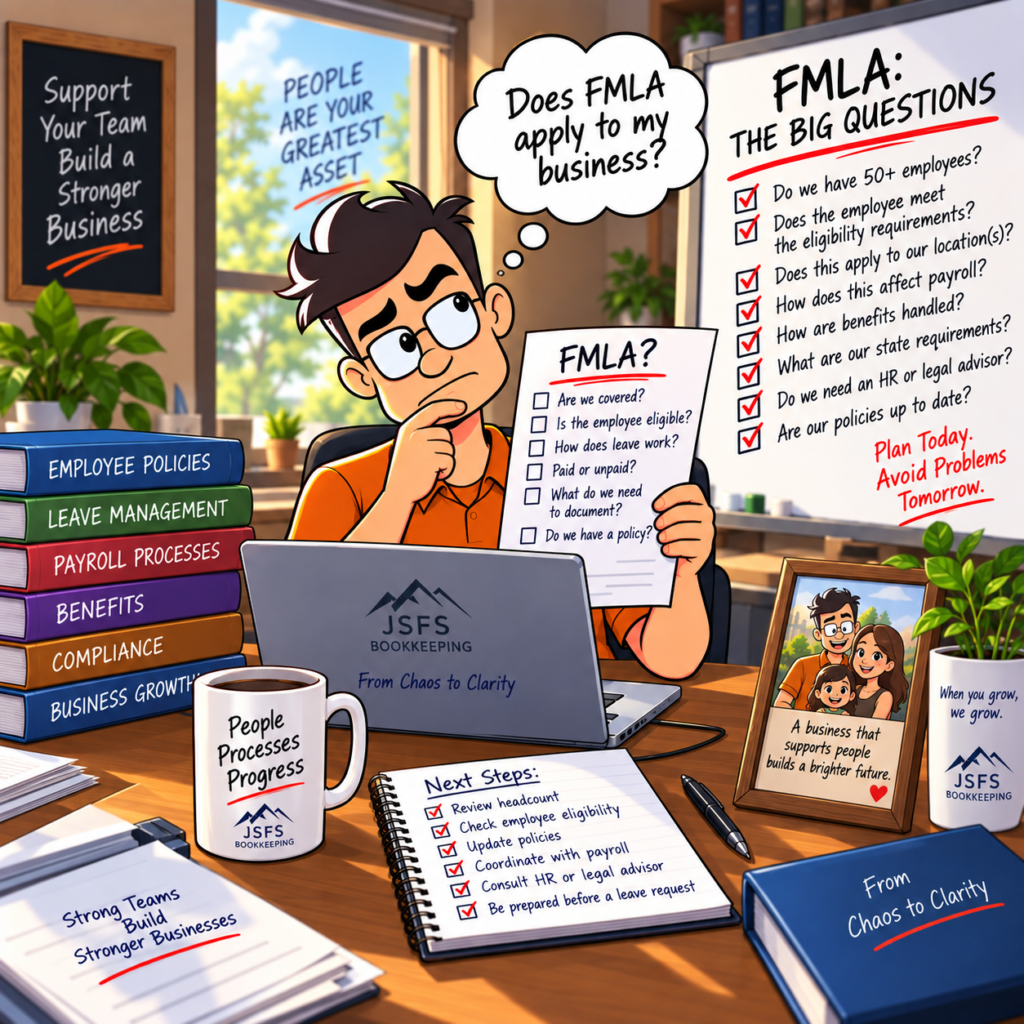
When an employee needs extended time away from work because of a medical or family situation, one of the first terms that often comes up is FMLA.
But here’s something small-business owners sometimes don’t realize:
FMLA does not automatically apply to every business or every employee.
The Family and Medical Leave Act is a federal law that provides eligible employees of covered employers with job-protected leave for certain qualifying family and medical reasons.
Before trying to determine what type of leave an employee may receive, however, there are two separate questions to answer:
Is the employer covered by FMLA?
And:
Is the employee eligible for FMLA leave?
Those aren’t necessarily the same thing.
Is Your Business Covered?
For most private businesses, the first number to remember is 50 employees.
Generally, a private-sector employer is covered by FMLA if it employed 50 or more employees during 20 or more workweeks in the current or previous calendar year.
Public agencies and public and private elementary and secondary schools have different coverage rules.
If you’re a small private business with five, ten, or twenty employees, federal FMLA generally isn’t going to apply to you simply because an employee needs medical leave.
But don’t stop the analysis there.
Other federal, state, or local employment laws may still apply, and your own company policies can also create obligations. When you’re dealing with an actual employee leave situation, getting qualified HR or legal guidance is always a good idea.
Covered Employer Doesn’t Automatically Mean Eligible Employee
Here’s another distinction that sometimes causes confusion.
Even when a company is covered by FMLA, an individual employee still has to meet eligibility requirements.
Generally, an employee must:
- Have worked for the employer for at least 12 months
- Have at least 1,250 hours of service during the 12 months before the leave begins
- Work at a location where the employer has at least 50 employees within 75 miles
So simply saying, “We have more than 50 employees, so this person qualifies for FMLA,” doesn’t answer the entire question.
You need to look at both the employer and the employee.
Why Should a Smaller Business Care?
You might be thinking:
“We only have 15 employees. Why do I need to know any of this?”
Because businesses grow.
If you have 35 employees today and you’re hiring rapidly, this is something you want on your radar before you cross the threshold.
It is much easier to establish policies and procedures ahead of time than to discover after an employee requests leave that your responsibilities have changed.
There is also another important reason.
Even when federal FMLA doesn’t apply, employees can still have rights under other employment laws, and employers may voluntarily offer leave benefits through their own policies.
Don’t use “We’re too small for FMLA” as shorthand for “We don’t have to worry about employee leave.”
Those are two very different statements.
Where Payroll and Bookkeeping Enter the Picture
Once leave has been approved, somebody has to make sure it is handled properly in payroll.
FMLA leave itself may be unpaid, although paid leave may sometimes run concurrently with FMLA depending on the circumstances and applicable policies.
That can create payroll questions:
How should the employee’s time be entered?
Are they using PTO?
How are benefits handled?
Are payroll deductions still being taken?
How should the leave appear in the payroll system?
Who is responsible for telling the payroll processor when the employee returns?
These questions shouldn’t be answered for the first time while somebody is trying to run payroll.
HR Decisions and Payroll Execution Need to Communicate
One thing we see frequently in small businesses is that HR decisions and payroll decisions happen in two separate worlds.
Someone approves something.
Then payroll finds out about it later.
That is how errors happen.
Your HR professional or employment attorney should help determine what you’re required to do.
Your payroll and bookkeeping processes should make sure what you decided to do is actually carried out correctly.
Those roles work together, but they aren’t interchangeable.
Know the Rules Before You Need Them
Good business systems are usually built before there is an emergency.
If your business is approaching 50 employees—or if you aren’t sure whether FMLA applies to your organization—now is a good time to review your policies.
Know who handles leave requests.
Know who communicates changes to payroll.
Know where the documentation is maintained.
And know when you need professional HR or legal guidance.
You don’t need to become an employment-law expert to run a small business.
You do need a process for knowing when to call one.
At JS Full Service Bookkeeping, we believe financial systems work best when the different pieces of your business communicate with each other.
From Chaos to Clarity isn’t just about cleaning up the books. It’s about building processes that help keep them clean.
This article provides general business information and is not legal or HR advice. Employers should consult qualified HR or legal professionals regarding FMLA and other employment-law requirements applicable to their specific circumstances.